
Last week we hosted economist Warren Hogan and entrepreneur-investor Carl Hartmann at our offices for our 2026 State of the Nation briefing. Warren has spent decades analysing the Australian economy, including a seven-year term as Chief Economist at ANZ and ongoing work advising government and business through his firm EQ Economics. Carl is a multi-award-winning Australian founder and investor, best known for co-founding global technology and consumer brands such as Temando, Compono and Lyre’s Non-Alcoholic Spirits, and serving as Adjunct Professor of Entrepreneurship and Innovation at the University of Queensland.
Across the evening, Carl distilled Noosa down to three concepts: lifestyle-premium, supply-constrained, and currency-aware. That is the cleanest articulation I have heard in a decade of selling property in this market of why Noosa behaves differently to the rest of the country. The remainder of this piece is what those concepts mean in practice, why they hold up against the macro picture Warren laid out the same evening, and what they imply for any vendor, buyer, or investor making a decision in the next twelve to eighteen months.
The national context, briefly
Warren’s read on the macro environment is sobering, and worth stating plainly before discussing Noosa specifically. Australia’s fiscal position has materially deteriorated. Government spending continues to outrun economic growth by a wide margin. His base case from here includes two to three further rate hikes. A cash rate around 5% likely produces a garden-variety recession. A cash rate above 6%, in his view, risks conditions closer to those of 1991.
Layered onto that is a global energy shock running through the Strait of Hormuz, feeding directly into Australian inflation.
This is the national storm. It is real, it is broad, and anyone arguing prestige property is immune to it is not reading the room. The question this piece addresses is narrower and more useful: is Noosa in that weather pattern, or operating outside it?
My view, drawn from Reed & Co’s own transaction data across the last five years post-Covid and from the patterns we see in active buyer enquiry, aligns with Carl’s. Noosa is operating on a different set of structural drivers. They are durable, and most of them are strengthening. Three of them, in the order Carl arranged them.
Lifestyle-premium
The serviceability stress driving the national narrative does not impact the bulk of the cohort buying prestige property in Noosa.
The dominant buyer profile in Noosa remains discretionary, equity-driven, and largely insulated from traditional serviceability constraints, with a high share of cash and low-LVR purchases in recent transaction data. That matters, because it changes the primary transmission mechanism of interest rates for this market relative to the broader, mortgage-dependent segments.
In most markets, rates act directly through borrowing capacity; in Noosa, they act indirectly through asset values, liquidity, and confidence, as equity portfolios, business valuations and global credit conditions move with the cycle. For this cohort, rates may not determine whether they can transact, but they can influence when they choose to, and on what terms.
Two structural demand drivers continue to reinforce this segment. The first is intergenerational wealth transfer: large capital flows from Baby Boomers to Gen X and Millennials are underway, and lifestyle destinations like Noosa are already proven recipients of a share of that capital, alongside other domestic and international alternatives. The second is the persistence of the post-2020 relocation cohort, where executives, founders and professionals who moved north have embedded families, schools and networks and are now upgrading rather than retreating.
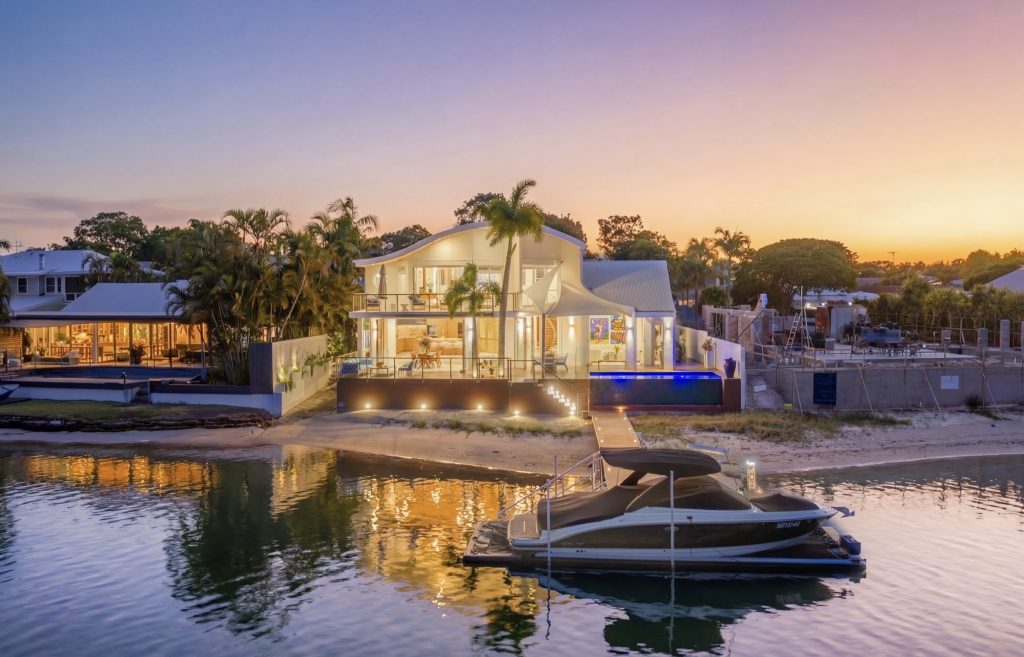
Prestige in Noosa does not sit as a thin layer above a broader market; it plays a dominant role in price formation across key precincts. That is what “lifestyle-premium” means in practice.
Supply-constrained
This is the most under-appreciated variable in any forward read of this market, and it has been a proven pillar of growth for the last decade.
Noosa Council’s planning regime, in place since the 1980s, caps building heights at three storeys, protects Hastings Street, contains development against the national park boundary, and limits any meaningful expansion of waterfront frontage on Noosa Sound, Noosa Waters, and the river system. The supply of genuinely prestige stock is finite and effectively closed.
Other markets correct in part because supply catches up to demand. Noosa’s cannot. National housing supply commentary, including the current federal and state targets, has almost no application here, because the binding constraint is planning, not construction capacity.
The international comparator set confirms the dynamic. Aspen, Palm Beach (Sydney), the Hamptons, Byron’s prestige tier, Queenstown, Mallorca: destination markets driven by discretionary high-net-worth buyers and constrained by planning. The empirical record from that cohort is consistent. Shallower corrections. Faster recoveries. Wider price spreads versus their broader regional markets through cycles. Noosa belongs in that comparator set. It does not belong in the Australian capital-city residential set. Measuring it against the latter has been one of the more persistent analytical errors in commentary on this market.
Currency-aware demand
The third element in Carl’s framing is the one most under-discussed in domestic commentary, and it is increasingly material.
The AUD has been weak against the USD, SGD, and EUR for an extended period. For an Australian buying their primary residence with AUD income, this is invisible. For the cohort buying in Noosa, much of which carries international exposure, it is a significant pricing variable.
Returning Australian expats redeploying offshore wealth into Noosa are converting from USD, SGD, or GBP into AUD at favourable rates. Their effective entry price into prestige Noosa stock is materially below what the AUD-denominated headline suggests. The same logic applies to permanent residents settling in Noosa with offshore wealth, and to the smaller cohort of foreign buyers able to access prestige stock through FIRB-compliant pathways.
The implication is that a meaningful slice of the active prestige buyer pool in Noosa is not pricing this market in AUD at all. They are pricing it in their home currency, and the AUD headline price is the secondary consideration. That insulates the market from the AUD-denominated affordability pressures that drive the national conversation.
Domestic buyers still make up a large portion of the market and ultimately anchor broader pricing, so this dynamic should not be overstated as a universal hedge. It is more accurate to describe Noosa as currency-aware than currency-hedged: for a subset of buyers, exchange rates are a meaningful input into decision-making and can influence clearing prices at the margin.
The position, plainly
Carl’s three positions hold up. Noosa is lifestyle-premium, supply-constrained, and currency-aware. Those are not slogans. They are structural descriptions of a market operating on different inputs to the one Warren was diagnosing the same evening.
For those that know my love of the ocean and boating, here is a metaphor that I think covers the state of play. “Noosa is not a tougher boat in the same storm. It is in a different ocean, with different weather, driven by different forces.”
For buyers and vendors, the advantage lies in understanding those differences clearly and avoiding the mistake of reading Noosa through a purely national lens.
By Adrian Reed, Founder and Director, Reed & Co