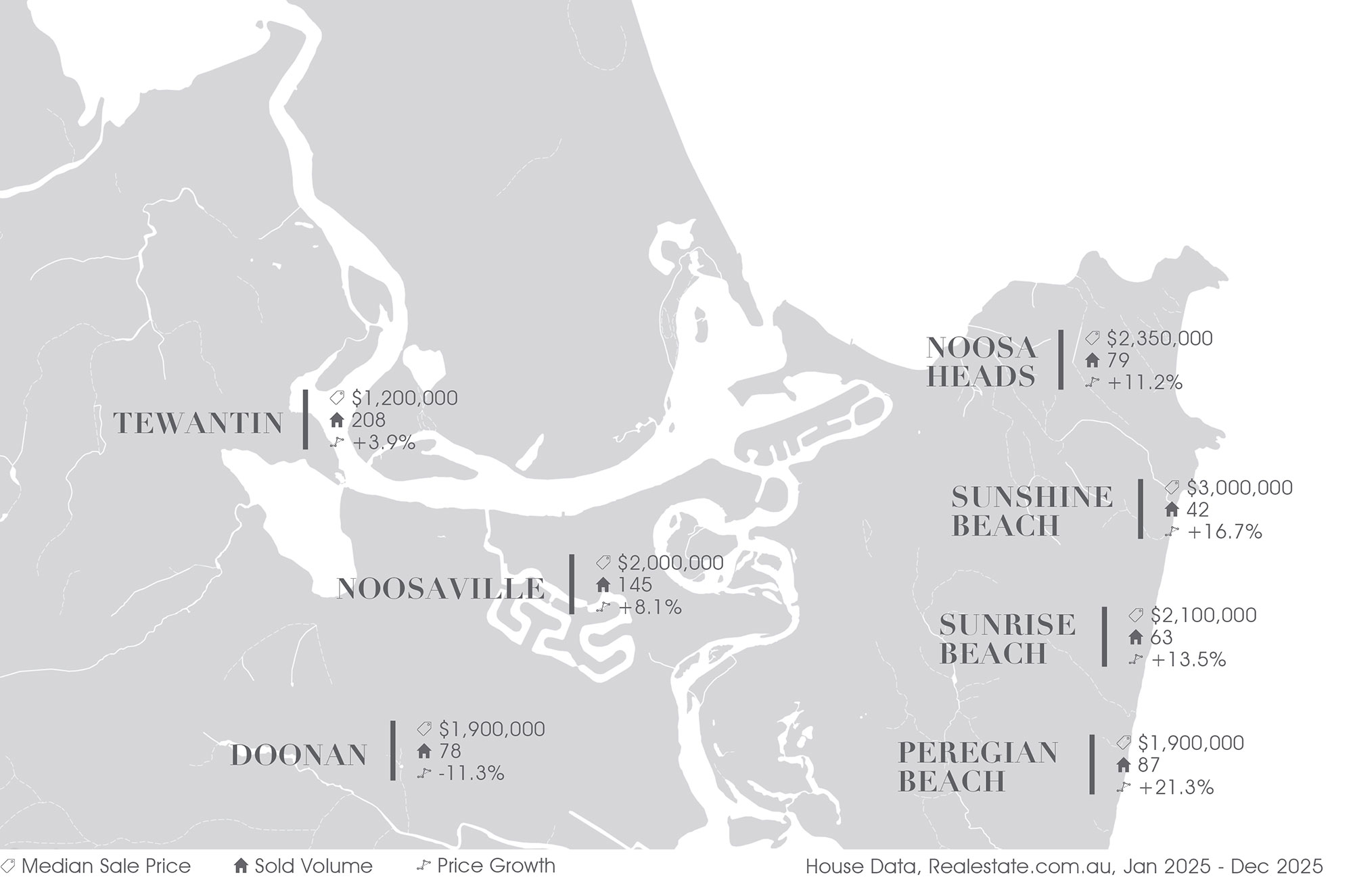
As 2025 drew to a close, the Noosa property market has delivered a year of resilience, selective strength and measurable divergence across our local suburbs. Coastal precincts, led by Noosa Heads, Sunrise Beach and Peregian Beach have outperformed the broader Sunshine Coast and national averages, with double-digit price growth and robust sales volumes. The hinterland and peripheral areas have recorded more modest but steady gains, reflecting a market that continues to reward location, character and supply scarcity above all else.
Monetary Policy and the Rate-Cut Effect
The Reserve Bank of Australia delivered three 25-basis-point rate cuts across 2025, reducing the cash rate from 4.35% to 3.60% and then holding steady into year’s end. This earlier-than-expected easing cycle fundamentally reshaped buyer psychology and serviceability metrics across the Australian housing market, with first-home buyers and upgraders re-engaging as borrowing capacity improved and rate-cut expectations became front of mind. The Westpac Housing Pulse in late 2025 highlighted that the national “time to buy” index had pushed to a cycle high, signalling that sidelined buyers were moving back towards active intent. The cumulative effect was a high single-digit rise in national dwelling prices over calendar 2025, with further gains expected in 2026 as lower rates continue to filter through refinancing, equity release and new lending channels.
Consumer Sentiment and Price Expectations
Despite persistent cost-of-living pressures, Australian consumer sentiment on housing shifted materially across 2025. The Westpac-Melbourne Institute house price expectations index reached a new cycle high of 172.4 in November 2025, with over 80% of consumers expecting residential prices to rise over the next 12 months. This is particularly pronounced in Queensland, where intergenerational wealth transfer, interstate migration and established demand fundamentals have anchored optimism. Critically, this optimism has been selective. While the time-to-buy index has improved, the “time to sell” index remains compressed, meaning vendors are not yet convinced they should exit, and buyers remain wary of overpaying. This creates a market where winners are those with clarity, flexibility and insider knowledge of value.
The Coastal Outperformance Story
Noosa’s coastal precincts delivered strong absolute and relative performance across 2025. Noosa Heads, Sunrise Beach and Peregian Beach, our genuine premium precincts, averaged price growth of 15.3% for the year, well above the national average of 6-8% and significantly ahead of the broader Sunshine Coast.
- Peregian’s acceleration: Peregian Beach’s 21.3% growth stands out as the strongest performer in the Noosa cohort. This reflects growing recognition that genuinely beachfront and walkable precincts are increasingly scarce, coupled with strong buyer migration from Sydney and Melbourne seeking value relative to comparable properties in those capitals.
- Noosaville’s steady hand: Despite recording “only” 8.1% growth, Noosaville remains the volume driver with 145 sales, indicating a healthy market for waterfront and near-waterfront homes in the $1.8m-$2.2m band. This is the market where lifestyle buyers and upgraders are most active.
- Tewantin’s moderation: Tewantin’s +3.9% growth reflects a market for more affordable entry-level and mid-range properties, serving owner occupiers and investors in the $900k-$1.4m range. Sales volume (208) remains robust, suggesting solid underlying demand.
- Doonan’s contraction: Doonan’s -11.3% decline warrants attention. It reflects a rotation in buyer preference away from larger acreage and rural-lifestyle properties toward high-density, walkable, beachside precincts. This is a trend we have observed across rural lifestyle markets nationally as buyers prioritize convenience and access over land size and privacy.
Global and National Prestige Performance
Despite economic headwinds, the ultra-luxury residential market remained resilient through 2024-2025. Knight Frank’s Wealth Report 2025 highlights generally positive outcomes across Australia’s leading coastal markets, with lifestyle destinations outperforming capital city cores.
In Australia’s prestige segment (top 1-2%), Brisbane and South-East Queensland ranked among the strongest performers, recording annual growth of approximately 8-15%. Lifestyle markets such as Noosa and the Gold Coast captured a disproportionate share of this growth, driven by interstate migration, relative value compared to Sydney, and demand for established coastal living. By contrast, comparable global markets including Miami, Los Angeles and parts of the UK Riviera recorded more modest growth (2-6%), reinforcing Australia’s competitive value position.
For Noosa, this global context is critical. Domestically, it sits alongside Byron Bay, the Mornington Peninsula and the Gold Coast; internationally, it compares with tightly held coastal lifestyle markets such as Miami Beach and the Amalfi Coast – yet remains materially more affordable on a per-square-metre basis. This value asymmetry continues to attract capital.
The Queensland Buyer – A Shift in Dynamics
While often assumed to be driven by Sydney and Melbourne buyers, Queensland-based capital dominated Noosa’s prestige market in 2025. The most decisive purchases came from Brisbane buyers and existing Noosa owners trading up.
A defining transaction was the sale of 29 Cooran Court, Noosa Heads, one of Queensland’s highest residential sales of the year, acquired by a Brisbane buyer in the high-$20m range. Sales across the $6m-$30m bracket reflect a consistent theme: a mature, confident local high-net-worth cohort securing irreplaceable assets with long-term hold strategies in a supply-constrained market.