Thinking of Selling? Discover the value of your home
NOOSA PROPERTY MARKET REPORT
FY 2025/26 in Review
For all the caution in the national conversation this year, Noosaís numbers tell a confident story. The median dwelling value across the Noosa local government area finished FY2025/26 at $1.52 million, up 9.3% over the year. Houses led, up 9.9% to a median of $1.60 million, while units rose 7.9% to $1.37 million. Set against a national median of $938,000, the typical Noosa home now sits at roughly 1.6 times the value of the typical Australian one.
That premium is not new, and it is not an accident. Over the past decade Noosa values have climbed 119%, comfortably ahead of the 74% national gain. This is a market that compounds, and it does so because the thing it sells cannot be made in greater quantity.
And yet the year did not feel uniformly strong, because it was not. The momentum that carried values higher for most of the year eased in the final quarter, with the median slipping about 0.6% off its peak. Sales volumes, while up on last year, still sat below the ten-year average. The market grew, but it grew with the handbrake gently on toward the end.
This is the gap worth understanding. The full-year numbers were strong. The closing months were quieter. Both are true, and reading only one of them would mislead you. Values rose across the year and then steadied. Urgency, not price, was what came out of the market as FY2025/26 closed.
A single median across the whole LGA hides as much as it reveals, because value and behaviour told different stories at different ends.
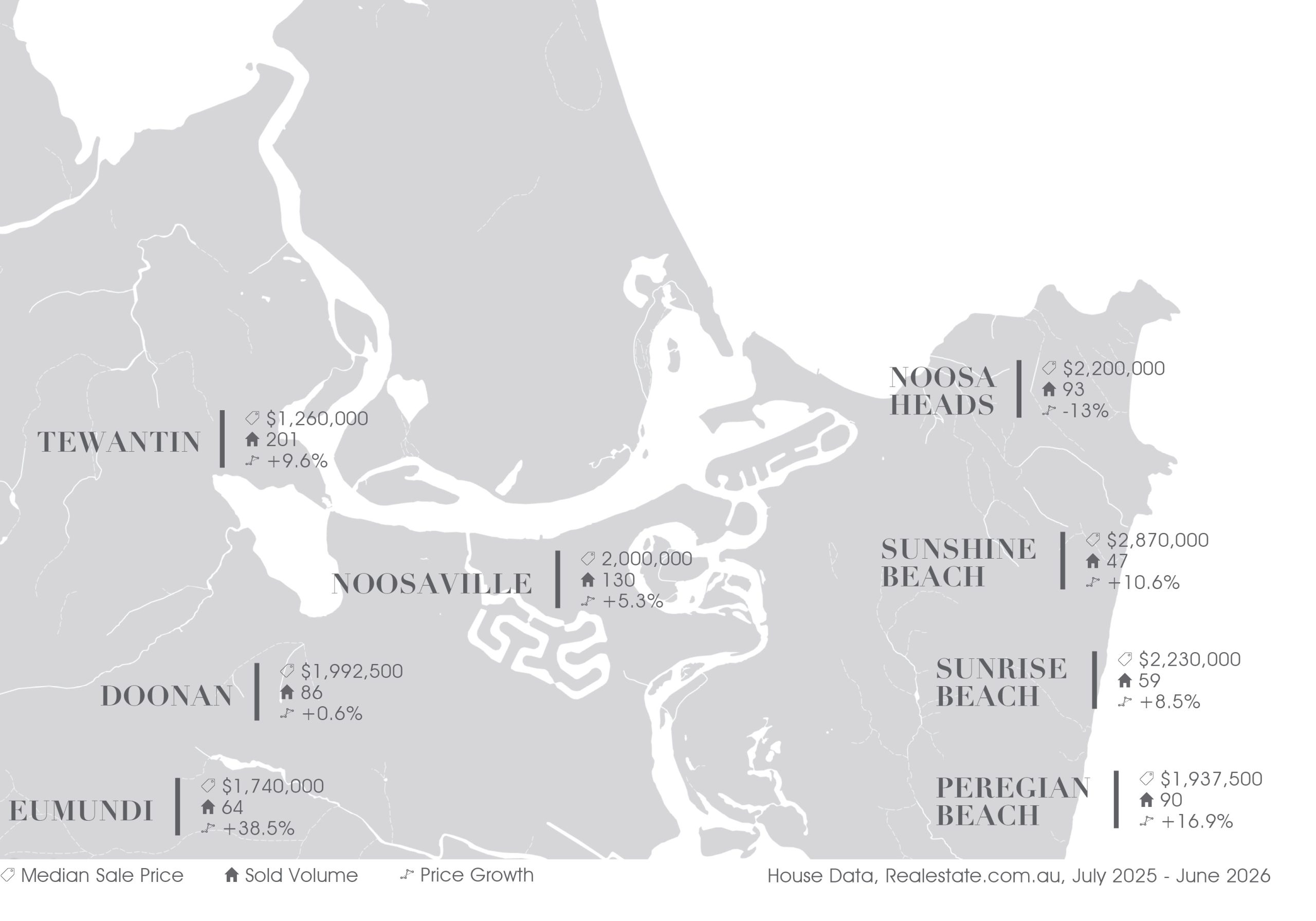
Through the prime and mid ranges, the market moved well. Well-presented, well-priced homes found buyers without much drama, and the strongest pockets, suburbs like Sunshine Beach and Peregian Beach, grew by double digits. These buyers are mostly purchasing a home to live in. They respond to a sensible price, not to the mood of the moment, and they kept the market turning over.
At the very top, above roughly $8 million, behaviour changed. Campaigns ran longer, buyers negotiated harder, and fewer trophy homes traded. But this tier is held by owners under no pressure to sell, so price discovery slowed onto their terms rather than collapsing. The homes that did trade held their level. Scarcity at the top does not soften. It waits.
The Rising Cost of Holding
In March 2026 the Valuer-General reissued land valuations across Queensland. Noosaís unimproved land values rose 37% in a single revaluation, the first since 2023. That figure is not a measure of scarcity and it is not a signal about market values. In practice it is a revenue lever. The unimproved value the state sets drives two separate charges, council rates and state land tax, and a higher valuation lifts both without a single policy being announced.
Council, at least, softened its side. Facing the revaluation, it cut the rate in the dollar so the rise for most owner-occupiers landed at 6.9%, about $134 a year. But even that restraint sits on shaky ground. Councilís own budget speeches put operating costs rising close to 9% a year, from $151.6 million to $163.5 million, while rates were held below that. Holding rates under your own cost growth is not free. It defers maintenance, leans on the rate base, and points to steeper rises ahead. Several councillors said as much, calling openly for a spending review and a return to the basics.
A principal place of residence is exempt from land tax, so the roughly 70% of Noosa buyers who live in their homes are untouched. The charge falls on the investor and holiday-home cohort, and it bites hardest on the many prestige holdings held in trusts and companies. For those owners, a 37% valuation rise is a real and rising cost to simply hold what they own.
Serious Money is Still Building
Serious capital is backing Noosa at the top of the market. Three five-star moves are underway at once. The team behind Brisbaneís Calile Hotel won approval for a new luxury resort in Noosa Heads, 153 rooms and 29 suites plus villas, an investment estimated to add more than $300 million to the local economy. Noosa Springs secured approval for a 69-room boutique hotel. And the Sofitel, now the Elysium Noosa Resort, is midway through a full renovation.
You do not commit that kind of money to a market you expect to fade. This is patient, long-horizon capital making the same judgement our buyers make: that Noosa is a scarce, enduring destination, and that demand to be here is structural rather than cyclical.
That is the Noosa market in FY2025/26. Values up strongly across the year but cooling inline with the National sentiment, turnover recovered, the pace easing at the close, and a top end that paused rather than retreated. The fundamentals held. What changed was confidence, and that is a story worth telling on its own terms.
The Economic Outlook with a Local Context
he national and global backdrop shifted through FY2025/26, and not in the direction most forecasters expected a year ago. The story of the year was not the rate cut everyone had been waiting for. It was inflation coming back.
A conflict in the Middle East disrupted global oil supply and pushed energy prices sharply higher. That fed straight into inflation, and then into the price of almost everything that moves on a truck or runs on power. Australian inflation, which had been easing, turned and climbed again. By May 2026 it was running at 4.0%, still well above the Reserve Bankís 2 to 3% target.
The Reserve Bank responded the only way it could. Rather than the cuts the market had priced in, it raised the cash rate three times over the year, to 4.35% by June, and made clear it would go further if inflation did not come back into line. Any prospect of relief has been pushed out to 2027 at the earliest. For anyone with a mortgage, the year delivered the opposite of what they were promised.
There is a structural reason this inflation has been so hard to shift, and it sits with government as much as with the oil price. Public spending is at a record high, the largest share of the economy in almost forty years outside the pandemic, and the fiscal impulse has been expansionary for two years running. Reserve Bank Governor Michele Bullock has taken to calling Australiaís inflation ìincreasingly homegrown.î The economist, fund manager and Noosa owner Christopher Joye has put it more bluntly, arguing that the real pressure on interest rates is coming not from households or business but from government spending that stayed elevated long after the pandemic passed, and that this fiscal impulse set Australia up for a longer rate cycle than most expected. The three hikes this year suggest he was right.
For the property market, the implication is simple. Inflation that is partly homegrown is stickier than inflation that is purely imported, and stickier inflation means interest rates stay higher for longer. The higher-for-longer environment is not a temporary detour. It is the more likely base case, and it is exactly the environment in which unleveraged, real, scarce assets do their best work.
The Plan Ahead
None of this is to pretend the road is smooth. It is not, and it would be a disservice to say otherwise.
Business confidence took a heavy hit this year. When the Middle East conflict broke out, the NAB survey recorded its second-largest monthly fall on record, matched only by the GFC and the onset of COVID. It has clawed back some ground since, but it remains in negative territory, and business conditions are running below their long-run average. Cautious firms hire and invest less.
The labour market is softening with it. Employment growth has slowed to well under half its recent pace, and unemployment has begun to tick up. Layered over that is the slower structural shift of artificial intelligence. There is little sign yet of wholesale job losses, but hiring in knowledge-heavy fields, finance, professional services, media, is already cooling, and the pipeline into entry-level professional work is narrowing. The full effect will play out over years, not months, but the direction is set, and it introduces a kind of uncertainty into white-collar careers that was not there a decade ago. Add continued geopolitical instability, and the honest summary is that there are bumps ahead.
But uncertainty does not sit still. It moves money, and it moves decisions. When the financial world feels less predictable, capital looks for things that are tangible, scarce and understood, and people bring forward the lifestyle choices they might once have deferred. Both instincts point in the same direction, and it is not the capital cities.
Where the Drag Actually Lands
Higher rates do their work through debt. They bite hardest on the household or investor carrying a large mortgage, and that is exactly where the national market has felt it. The Reserve Bank itself noted that housing momentum has shifted, with prices falling in some capital cities. Borrowed money has become more expensive and more cautious, and leveraged markets have slowed accordingly.
This is where Noosa separates from the national picture. The buyer setting prices at the top of this market is not borrowing. The self-funded retiree converting superannuation and a lifetime of accumulated wealth into a home is largely indifferent to the cash rate, because it is a cost of debt they do not carry. The confidence drag a rate environment creates is real, but it is a drag on borrowers, and the borrower is not the marginal buyer here.
There is a second effect that runs in Noosaís favour. When inflation is high and financial markets are uncertain, the case for holding wealth in a scarce, real, useful asset gets stronger, not weaker. Cash loses value in real terms. Financial assets wobble. A tightly held, irreplaceable piece of Noosa does neither. For the crystallised-wealth buyer, an inflationary year is not a reason to wait. It is a reason to move capital into exactly the kind of asset this market offers.
That is the quiet logic beneath a market that held its values while the national market softened. The conditions that hurt the leveraged buyer are the same conditions that make Noosaís store-of-wealth proposition more compelling.
The Home Tax System Rewards
The tax system now points harder than ever toward owning rather than investing.
The 2026 federal budget reshaped the treatment of investment property. From 1 July 2027 the 50% capital gains tax discount will be replaced with a narrower, inflation-based discount and a minimum 30% tax on gains, and negative gearing is being wound back. Whatever you make of it, the direction is clear. Holding property purely as a geared investment is less attractive than it was.
The family home was left entirely alone. The main residence keeps its full exemption from capital gains tax, with no cap on the gain that can be sheltered. It attracts no land tax. And it sits outside the age pension assets test. No other asset in the Australian system carries that combination. Superannuation is taxed and assessed. An investment property is now taxed harder. The home is the one place where wealth can grow, untaxed, while you live in it.
For the buyer converting a lifetime of wealth into a place to live, that changes the calculation. Putting more into the home, not less, is the tax-efficient move, and it is sharpest for the retiree, whose family home is not counted against them while the same money in super or shares is. Buying the best home you can hold, in a market that is scarce and appreciating, is not indulgence. Within the current settings it is one of the most efficient stores of wealth available.
From what we can see the system rewards the home, and it has just tilted further that way.
The Turn, When it Comes
Rates will not rise forever. Once the oil shock passes through and inflation settles, the pressure holding the market back will ease, and the conversation will turn to cuts, most likely through 2027. When it does, sentiment tends to move quickly and all at once, and the buyers who stepped back will step back in together.
The point for anyone weighing a decision is simple. The unleveraged buyer does not need to wait for that turn, because they were never held back by rates in the first place. And the seller who acts now does so into a field thinned by everyone else waiting for a signal. When the signal comes, the window of low competition closes with it.